
More than ten years before moving to Estonia, Furkan Öztürk had already found his way here—through music. As a young man in Turkey, he became an avid listener of Metsatöll, an Estonian folk metal band whose songs sparked his curiosity about a country he had never visited.
Today, Furkan calls Estonia home. He lives here with his Estonian wife, Ksenia, and their two chihuahuas, Sipsik and Punja, building a life that blends his Turkish roots with Estonian traditions. Between discovering Estonia’s bakeries and practicing the language at every opportunity, Furkan shares humorous cultural insights with his growing audience on Instagram.
A Heavy Metal Prelude to the North
Furkan’s connection to Estonia began as a purely emotional one. In the early 2010s, while exploring music beyond his usual hip-hop playlists, he stumbled upon Nordic folk metal.
“I was searching for folk rock and found Korpiklaani from Finland, then I saw Metsatöll,” he recalls. The music stayed with him so strongly that he even reached out to the band on Facebook, asking if they would ever perform in Turkey. They said no—but the seeds of interest in Northern Europe’s culture, its climate, and its languages were sown. “It was very interesting for me because it was so different from what I knew,” he says.
From eBay Turkey to the Silicon Valley of the Baltics
Although Metsatöll was Furkan’s first point of contact with Estonia, it would not be his last. As he started to learn more about entrepreneurship and innovation, the country’s name kept coming up again and again.
By the time he started university in 2017, Furkan had developed a strong interest in entrepreneurship. He was accepted into the Turkish Entrepreneurship Foundation—one of just 40 students selected from around 140,000 applicants nationwide. At the same time, he began attending startup-focused events organised by the United Nations and Google, where one word seemed to echo constantly in conversations about digital progress and new ideas.
“Estonia, Estonia, Estonia,” he heard.
While working at eBay Turkey, an unexpected corporate decision opened a new door. When the company announced it was leaving the Turkish market, Furkan took it as a sign to look abroad.
“I feel I need different cultures in my life,” he says. “My mother is a Greek immigrant but Turkish, my father is Turkish. Multiculturalism is in my DNA.”
He applied for a European Union project and was accepted into Pärnu Huub, an innovation centre on Estonia’s west coast. In February 2023, he moved to Pärnu from Adana, Turkey, ready to dive into Estonian life.
A metal fan meets his heroes
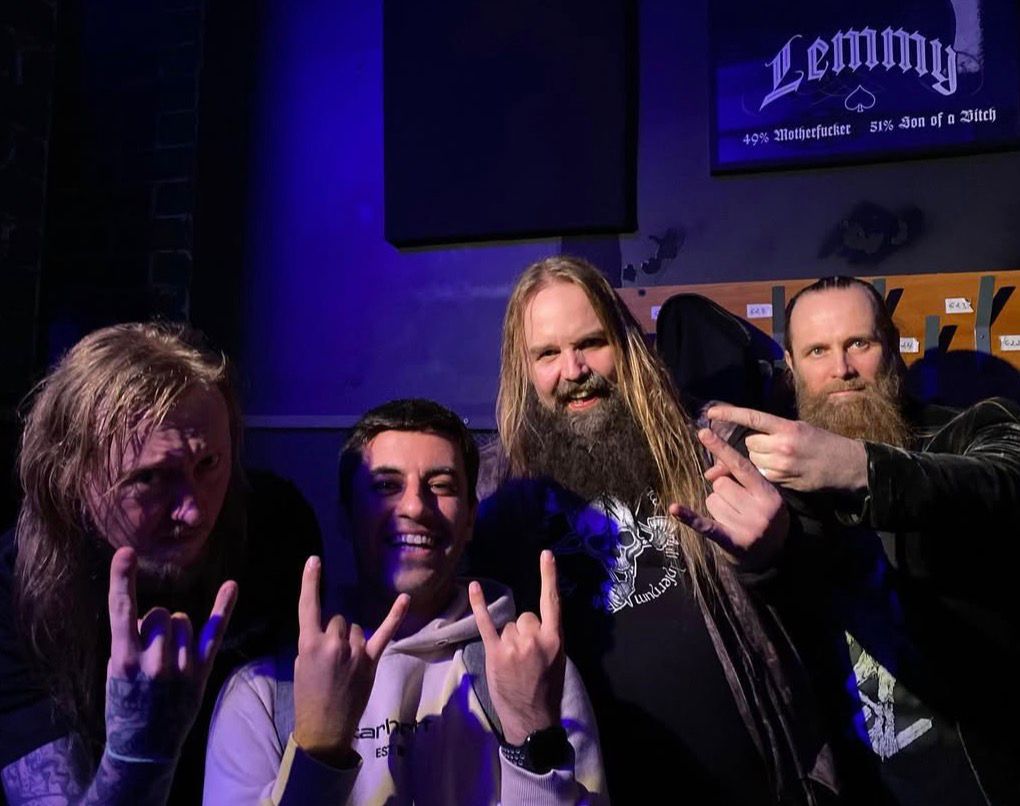
Shortly after arriving, Furkan finally saw Metsatöll live in concert in his new home town.
“I even met them after the concert and we took a selfie together,” he says proudly. “I don’t know if they remembered me, but who writes from Turkey, right?”
His first weeks in Estonia were full of symbolic moments. On 24 February, he joined the Independence Day celebrations in Pärnu.
“As a Turk, I have a deep respect for the independence of other countries. During the Independence Day celebration, I held a huge Estonian flag for hours. I didn’t understand anything people were saying,” he admits. “But later, my friends told me the announcer had said, ‘Our Turkish friend and our Latvian friend, welcome.’ It was really exciting for me.”
Love, languages, and two tiny dogs
Life in Estonia eventually led Furkan to his wife, Ksenia. Their household is a beautiful blend of cultures. Ksenia has Estonian, Russian, and Ukrainian roots.
“We live in a very multicultural home,” Furkan laughs. “Sometimes we speak Estonian, sometimes Russian, sometimes English. She has even started learning Turkish. For me, adaptation comes from respect for the language and history of the country you live in. That’s why I knew I had to start learning Estonian myself, too.”
Their journey has not been without its humorous hurdles. Moving from the spontaneous culture of Turkey to the structured rhythm of life in Estonia required some adjustment. Furkan admits that the Estonian “planning culture” was quite a shock.
“In Turkey, if I see you on the street, I might invite you for tea in two hours. Here, everything needs to be planned. Even for things like going to the hardware store, Ksenia will ask, ‘Why are you telling me this now? We have to make a plan!’” he laughs.
Practicing Estonian in everyday situations
Now living in Tallinn, Furkan is fully committed to building his life in Estonia. He recently passed his A1 Estonian exam with a high score and is moving on to A2, noting that the grammar—adding endings to words and using vowels like “ö” and “ü”—is surprisingly similar to Turkish.
To learn the language, Furkan joined the Settle in Estonia adaptation programme after hearing about it from a Turkish friend, and he quickly came to see it as one of the most valuable steps in his adaptation journey.
“The language courses are not always open—but when you get in, the programme is really helpful and it’s free of charge. The teacher was amazing.”
He insists on using Estonian in everyday interactions, such as ordering at a café, even when locals switch to English to help him. “I try to continue in Estonian,” he says.
“One time I said kohvik instead of kohv,” he laughs. “The cashier was like, ‘What?’ Then I said, Vabandust, üks kohv, palun.”
Building a life
Beyond formal courses, Furkan believes true integration is ultimately a matter of attitude.
“You have to be confident,” he says. “If you don’t make the first step yourself, you will always be a tourist here.”
When learning about Estonian history, something caught his eye. “Sweden was here, Germany was here, the Soviet Union was here—but even through all of that, Estonia protected its language. That is really important. Of course, other languages have had an influence, but Estonians have preserved their own. I respect that a lot.”
He follows Estonian media to stay up to date with the news and spends much of his free time learning about the country’s history. He even listens to Estonian radio. And while Metsatöll will always have a special place for him, he has also started to enjoy other Estonian artists, such as An-Marlen.
Forests, safety, and friendly police
What surprised Furkan most in Estonia was not technology—but calmness.
“When I moved to Pärnu from Turkey, the air felt so fresh,” he says.
On his second day after arriving, he saw police officers near the forest and decided to ask if the area was dangerous.
“They said: ‘Dangerous? No. You can walk everywhere, even at night.’”
In Turkey, people would be much more cautious in these kinds of situations.
“My friend in Pärnu didn’t even lock his door,” Furkan says. “I was shocked.”
An Instagram bridge between cultures
In the meantime, Furkan has become something of a cultural translator on Instagram.
He creates short videos about his discoveries in Estonia and gives international memes a Baltic twist. “People message me that they love my content because it is relatable,” he says. “Someone from Italy even told me they want to come back to Tallinn because of what they saw on my Instagram account.”
However, he is careful not to offend anyone with his content. “I always ask my Estonian friends if the videos I am planning to share are respectful?”
His goal is simple: to help people understand each other. “I feel I have a responsibility,” he says. “This is a small country. We have to protect it together.”
From metal music to belonging
Today, Furkan’s life in Estonia is far from that of the student in Turkey who once sent hopeful messages to his favourite band on Facebook. Whether he is hunting for the perfect vastlakukkel in Tallinn’s bakeries, filming a new viral clip about Estonian quirks, or walking Sipsik and Punja through the quiet streets of Tallinn, he is no longer just a spectator of the culture he once admired from afar. He is an active part of it.
From the heavy riffs of Metsatöll to the calm, fresh air of Estonian forests, Furkan has found his own rhythm in the North. He remains a proud Turk, but in the small, resilient nation of Estonia, he has found something equally valuable: a place to grow, a community to protect, and a home to call his own—one cup of kohv at a time.
The Settle in Estonia Programme is a free educational programme provided by the Estonian state which is intended to help the foreigners who have arrived in Estonia to adapt and become accustomed to local life more easily. We offer courses for people who have come to live or study in Estonia and have lived here for less than 5 years. For example, war refugees to whom Estonia offers international or temporary protection, as well as people who have come to Estonia to work or do business here or relocate with their family member. The adaptation program The Settle in Estonia Programme is free for participants. We offer language training and other courses to help you cope with everyday life in Estonia. Read more and register: https://integratsioon.ee/en/kohanemine. The adaptation programme is co-funded by the European Union and the state budget.